
Why now?
July 23, 2026


Back when I was at DN Capital, a venture capital firm in London, I spent my days sitting across from founders who reminded me a lot of myself. Ambitious, over-caffeinated, and armed with a pitch deck that promised to change the world (or at least Q3).
The usual questions were always on my mind. Is this idea venture-capital-worthy? Are these founders wasting their time pursuing it? Am I about to say something that will haunt this founder's therapy sessions for the next five years?
But there was one question that mattered more than all the others. If I couldn't get a good answer to it, the deal was dead. Doesn't matter how charming the founder, how sleek the deck, how promising the market.
Why now?
Why is this business possible now? Why are these founders, and probably a dozen other people in a dozen other WeWorks around the world, working on this exact idea right now?
The worst possible answer was: "There's been a change in regulation." Regulations get revised. Sometimes they revise you right out of business. The flip side of that answer is just as bad: "There's a gap in the regulation." Sure, and it will get closed the moment your growth curve is spicy enough to hit the newspapers. Ask my scooter-rental portfolio how that went. (Spoiler: not well. I was heavily, heavily invested. Please don't check my brokerage statements.)
A slightly better answer was: "Some technology just made this possible." That's better, but usually not enough. A single piece of tech looking for a business is almost always a solution in search of a problem.
The best answer, the one that made me lean forward in my chair, was a convergence. Many new technologies quietly stacked up until something new became inevitable. That's where the good businesses live.
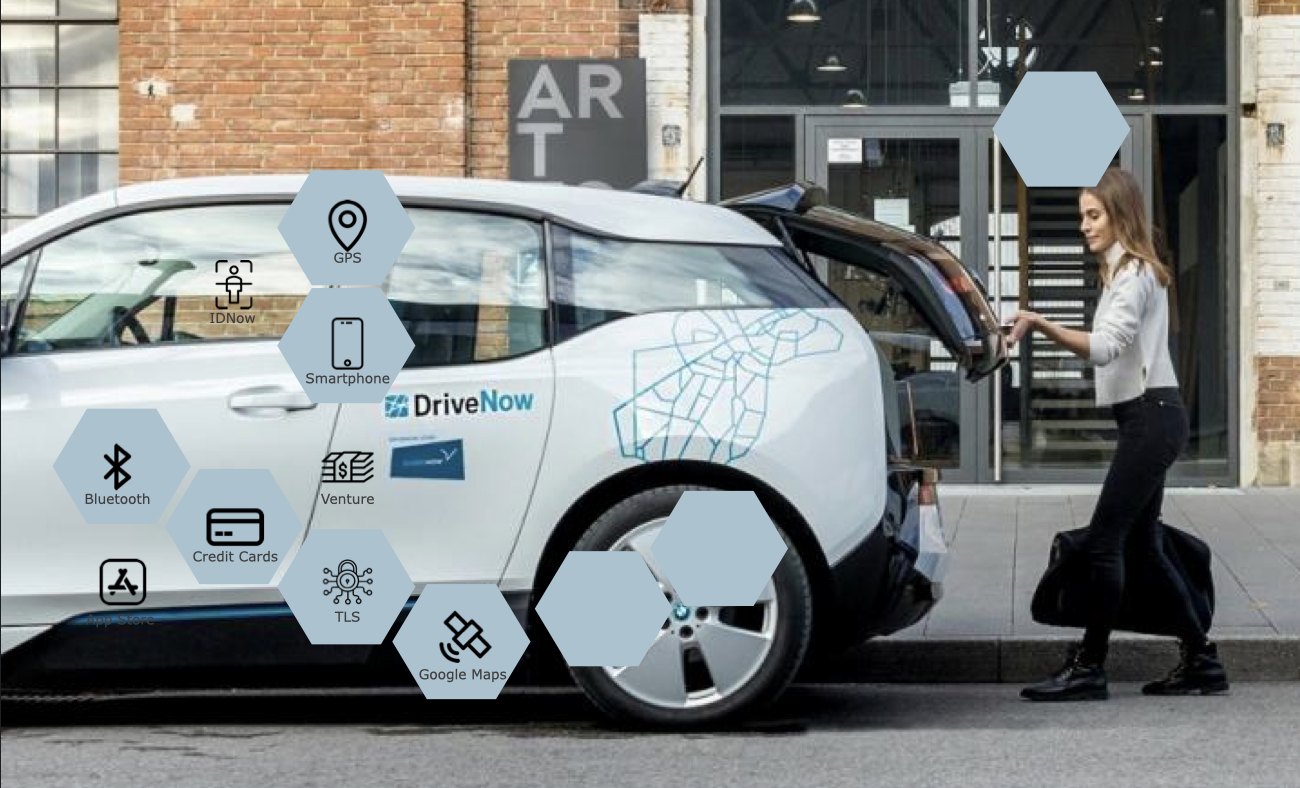
DriveNow is the textbook example. A free-floating car rental company that would have been science fiction a decade earlier. To pull it off, you needed: smartphones in every pocket, mobile broadband that actually worked, Bluetooth radios in phones, remote KYC over the internet, front- and back-facing cameras, mobile payments, Google Maps, and enough IoT in the cars to unlock the doors from a server. Take away any one of those and the whole thing wobbles. Stack them together and suddenly a fleet of over-logo-printed cars scattered across a city is not a logistics nightmare, it's a product.
Regulation? Yes, there was a gap around free-floating cars parking in city centers. But city governments were quietly cheering, because every free-floating car meant ten less privately owned car choking the curb. Sometimes the gap is a feature, not a bug.
Another one: WirKaufenDeinAuto. I did the TechDD on this for DN, and there really wasn't much tech to look at, honestly. But the business was ripping. Why? Two boring technologies had just gotten good enough at the same time: ad targeting and local SEO. Together they meant a national brand could show up in your feed the exact moment you started Googling "Restwert Golf 3" No fancy AI, no blockchain, no VR headset. Just two mature tools braided together at the right moment. The answer to "Why now?" wrote itself.
So these days, whenever a founder pitches me something (or, more often, whenever I catch myself getting excited about my own next idea), I make myself pause and ask the same little question.
Why now? What changed in the last two years, the last twelve months, the last week, that makes this business viable now, when it wasn't before?
If the answer is a shrug, keep the money.
2 Kommentare
[English below]
Danke, sehr interessant. Mercedes und BMW haben aufgegeben und DriveNow und car2go und auch den zusammengelegten Nachfolger ShareNow gibt es nicht mehr. VWs WeShare auch längst Geschichte. Nicht gewinnorientierte Carsharinganbieter die aus Vereinen hervorgegangen sind und mehr genossenschaftlich organisiert sind gibt es seit den 1990ern.
[ENGLISH]
Thanks, that’s very interesting. Mercedes and BMW gave up; DriveNow, car2go, and their merged successor, ShareNow, no longer exist. VW’s WeShare is also long gone. Non-profit car-sharing providers that emerged from associations and operate more like cooperatives have been around since the 1990s.
There has been a consolidation of the market, same with the scooters. That's what is happening when VC funds have a life span of 10+2 years.
DriveNow, was ShareNow is now Free2Move.