
The series setting the record straight on computer history continues. There most certainly was a GUI before Windows 95, and there most certainly was a computer age before MS-DOS.
In 1978, Apple was busy developing the Lisa computer. The idea was to build the next machine that would knock IBM off course. Apple was pursuing several other projects at the time. Thanks to the bestselling Apple II, the coffers were well filled. The company was growing. 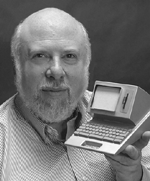 Jef Raskin was hired as employee number 31 after he had written the complete Integer BASIC manual for the Apple II. Over time he set up a new department for product testing and another one for application software. The chairman at the time, Mike Markkula, asked Raskin whether he wanted to work on a project called Annie. A games computer for under US$ 500. Raskin declined. He wanted to realize a project that had been on his mind for a long time. He called it Macintosh, and it was to be so easy to use that the man in the street could understand it without a manual. Markkula was enthusiastic about Raskin's idea and let him set up a department to design the Macintosh and bring it to market. The first approach was that the Macintosh should only have ports for external devices. Unlike the complicated Apple II, you were not supposed to be able to stuff it full of expansion cards. The user should never be forced to open the Macintosh's case. The original Mac was to have a 5″ screen, a 5.25″ floppy drive with 200KB of storage, an 8-bit processor, the programming languages BASIC and FORTH in ROM, a carrying handle, a weight of under 20 pounds and a battery that lasted 2 hours. The battery was firmly planned until 1980, but was then dropped. In the beginning, the thinking was that the Macintosh would be such a great product that people would take it with them everywhere. The target retail price was US$ 500 so that PITS (“Person in the Streets” – the target group not yet reached by IT) could afford this computer. It quickly became clear that this price could not be held. So many new ideas were added that within the same year the price climbed to US$ 1,500. A month later, in September 1979, the built-in printer and monitor were cut. From then on, the Macintosh was to have a TV output. They were back at 500 dollars. In the four years up to its release, the Macintosh's price went through quite a few ups and downs. At one point the main input device was a light pen, at another a joystick, until, as on the Lisa, it became a mouse. Nor did it make any sense to hand a PITS programming languages with which to write his own word processor. A word processor stored in ROM became a must.
Back then, not many people thought much of the Macintosh project. Steve Jobs included. In 1981 he came to the Mac department as manager after a dispute with the board. The board felt Jobs would be well placed there and could let off steam – after he had been rebuffed by the Lisa team. Jobs made it a personal matter and bet the Lisa team's project manager, John Couch, US$ 5,000 that the Macintosh would reach the market before the Lisa. It was a very optimistic claim, given that the Apple Lisa had already been in development for two years while the Mac was still at the concept stage. As an expression of this little feud, the pirate flag flew over the Macintosh building. Steve Jobs said about the appeal of belonging to the original Mac team
It's better to be a pirate than to join the Navy
Still, there was no shame in reusing for the Macintosh what the Lisa had brought forth. Thus the 6809E microprocessor was replaced by the far more powerful 680000 of the Apple Lisa. Naturally, this sent the price soaring. Jef Raskin didn't agree with this, which Steve Jobs couldn't have cared less about. Thanks to the new processor, the same one as in the Lisa, the Macintosh team could now also tap into software solutions developed for the Lisa. Making the Mac and Lisa compatible, however, was something Steve Jobs consistently refused. Steve Jobs began poaching people from the Lisa team and pinching technologies. Andy Hertzfeld, chief programmer on the Mac pirate team, said
We begged, borrowed or stole code wherever we could
The Mac became more and more like the Lisa. In feature set and in price. Jobs had the joystick/light pen controls replaced by the mouse, which Jef Raskin thought was a bad idea. He at least managed to give the Macintosh just one mouse button, for easier operation, instead of three as on the Alto. The Macintosh got Atkinson's QuickDraw routines from the Lisa team – so now it could display windows.
Jef Raskin and Steve Jobs clashed more and more often until Raskin drew a line and handed in his resignation in mid-1982. Dan Kottke, a Mac developer, described the relationship between the two like this
Jef Raskin and Steve Jobs were dominant personalities. Jef could have stayed if he hadn't opposed Steve Jobs. He got very worked up about certain things and then couldn't calm down again.
On January 19, 1983, the Lisa was released and Jobs had to pay his gambling debt to John Couch. It was only a year later, on January 24, 1984, that Apple introduced the Macintosh. It had a 68000 microprocessor at 7.83 MHz, a 9″ monochrome screen, a 3½” floppy drive with 400KB capacity and 128KB of RAM. The graphical user interface came with a resolution of 512×342 pixels, the programs MacPaint by Bill Atkinson, MacWrite by Randy Wigginton and the Finder by Bruce Horn and Steve Capps.

Apple's executives argued about the price until the very last moment. Manufacturing costs were 500 dollars. Steve Jobs hoped for a retail price of 1495 dollars. The usual Apple margin was 150%, so the price should have been 1995 dollars. But Apple's new president, John Sculley, had a 100-day, 15-million-dollar campaign that launched during Super Bowl XVIII with the “1984” commercial, and that drove the price up to 2495 dollars. Almost 2000 dollars more than Jef Raskin had wanted for it. PITS were no longer the target group. It was “the computer for the rest of us”, meaning those who had more money than they could spend.
Still, on the 100th day after the Macintosh's release, 72,000 units had been sold. By March 1987, Apple had sold a million Macintoshes. On March 17, 1987, Apple took six MacPluses off the production line and declared every one of them the one-millionth Mac. In recognition of its true father and namer, one was sent to Jef Raskin. It was his first Mac, and he still owns it today.
Sources:
Jef Raskin's website
Apple Confidential

 16 Views

Hallo Könnt ihr dass alles bisschen kürzer Zusammenfassen.BITTE!!!!
apple is cool
Wenn Ihr den Artikel kürz, dann haltet diese Langversion (über Link erreichbar?), im Hintergrund verfügbar.
Er ist gut geschrieben, informativ, bietet einen guten Einblick. Ich fände es schade, ihn zu kürzen.